Introducing tax intelligence: savings and risks, straight from your books
FinBaze now reads your books against UK tax law and points at savings, risks, deadlines and law changes, each with the records and the law behind it.
Emile Vos, founder of FinBaze
Most tax savings aren't lost because the rule is hard. They're lost because nobody looked at the books with that rule in mind, at the right moment. And most tax risks sit unnoticed in a ledger until a return, an audit or an adviser finds them.
Today we're introducing tax intelligence in FinBaze. It reads your books against UK tax law, as well as Dutch and US federal tax, and points at what matters: a saving you may be missing, a risk, a deadline, a threshold or a law change. Every point shows where in your books it comes from and which law it relies on.
It explains. It does not submit returns and it does not change your figures.
Savings and risks, from your own books
Go to Taxes → Tax advice and you see the points for your company. Each one is a kind you can act on:
- Saving: a deduction, scheme or relief you may be able to use, often with an estimated amount.
- Risk: something in the books that may not be compliant.
- Deadline: a claim, election or filing date that is coming up.
- Threshold: turnover or another figure getting close to a legal limit.
- Law change: a change in the law that affects your company.
- Missing details: a fact FinBaze can't read from the books, such as your legal form.
Optimisations it looks for
- The Annual Investment Allowance (AIA) on plant and machinery you bought.
- Full expensing on new plant and machinery above the AIA.
- VAT bad debt relief on invoices that will never be paid.
- The Employment Allowance on employer National Insurance, if you haven't claimed it.
- R&D relief on development costs, with the deadline to notify HMRC.
Risk factors it flags
- Input VAT reclaimed on business entertainment or private use.
- Services bought from abroad without the reverse charge.
- Taxable turnover getting close to the VAT registration threshold.
- A director's loan still outstanding at year end, with a s455 charge if it isn't repaid in time.
- Dividends paid above distributable reserves.
- Invoices booked into a VAT period you've already submitted.
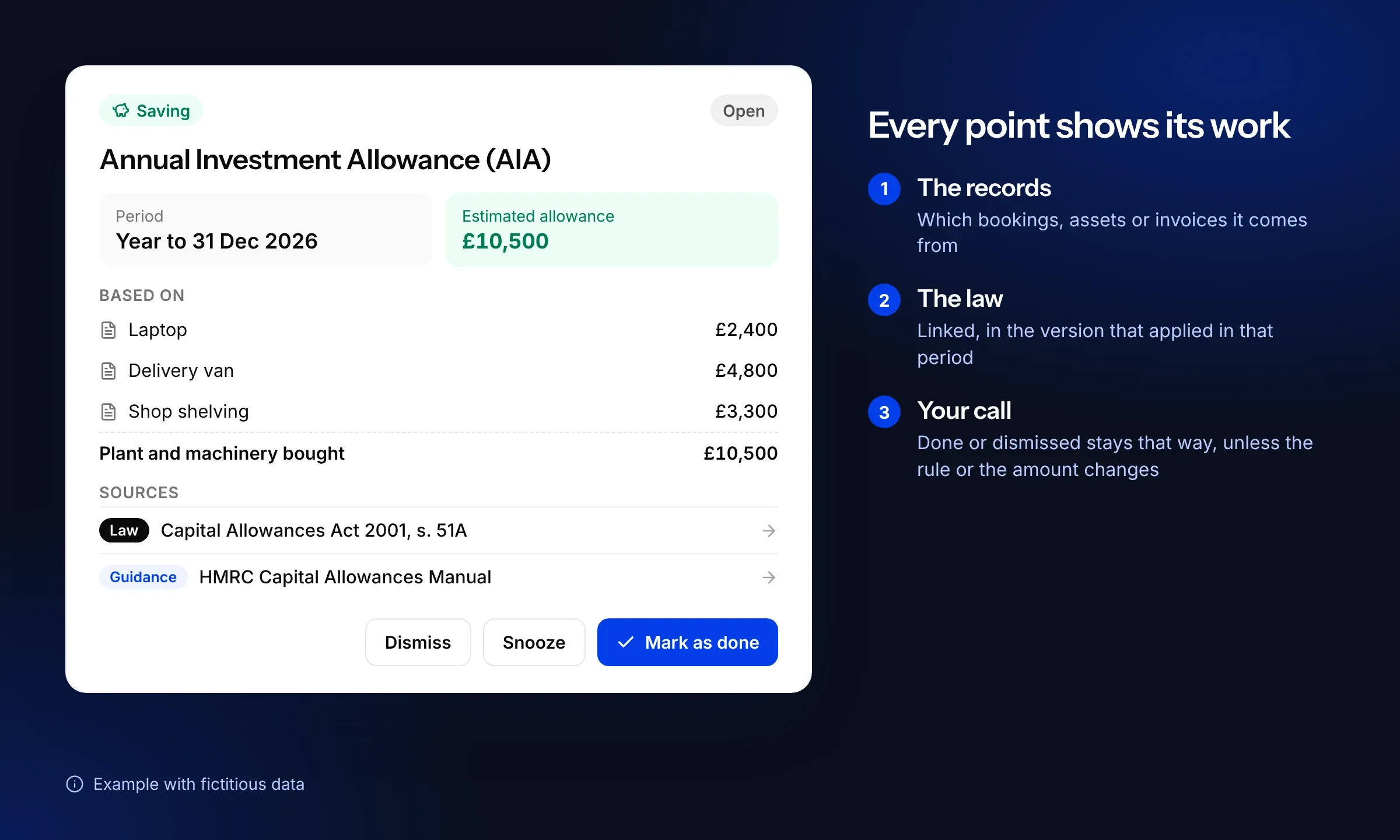
Each point shows the period, the deadline if there is one, the records it's based on and its sources. FinBaze checks again every night, whenever your books change, and when you click Check now. Fix the books and the point resolves itself.
Built on the law itself
A tax point is only as good as the law behind it. So before we wrote a single rule, we built a knowledge base of the law.
FinBaze keeps law, official guidance, case law, accounting standards and commentary, synced from the official sources: UK legislation, GOV.UK guidance including the HMRC manuals, and UK case law. The same goes for Dutch law and case law, and for the US Code of Federal Regulations and Federal Register.
Laws change, so every version of a text is stored with the date it applies from. A point cites the version that applied at the end of its period. Ask about 2024 and you get the law as it stood in 2024, not today's.
How search works
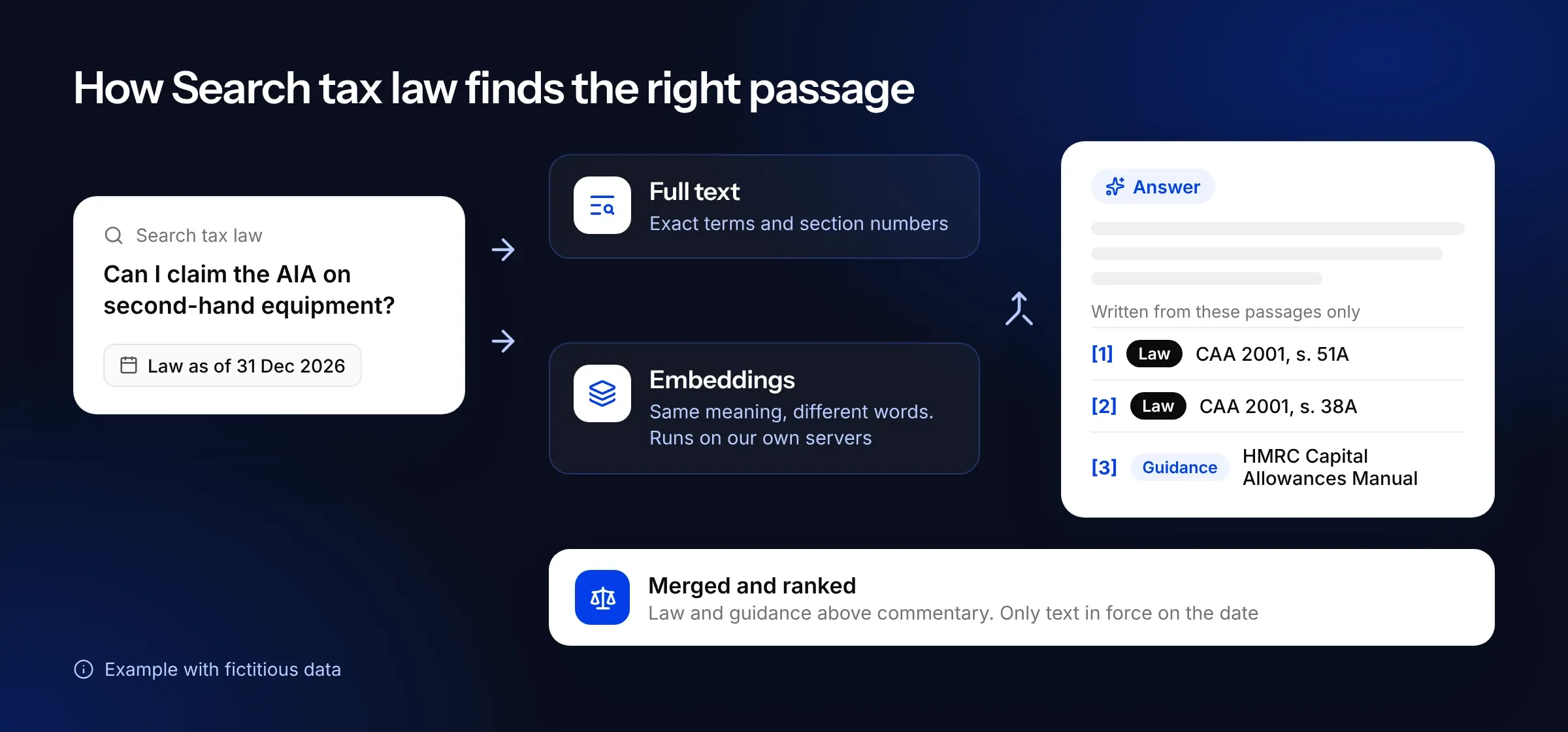
Every section of the law is split into passages and indexed two ways:
- Full text, so an exact term or section number is always found.
- Embeddings, so a question finds the right passage even when it uses different words than the law does. We use one model for English and Dutch text, running on our own servers.
Both result lists are merged, and official law and guidance rank above commentary. When a consolidated law is republished, passages that didn't change keep their index, so only what really changed is processed again.
You can search it yourself with Search tax law at the bottom of Tax advice. FinBaze finds the passages, writes an answer from those passages only and keeps them visible next to it. If the sources don't support a reliable answer, it says so.
Where the rules come from
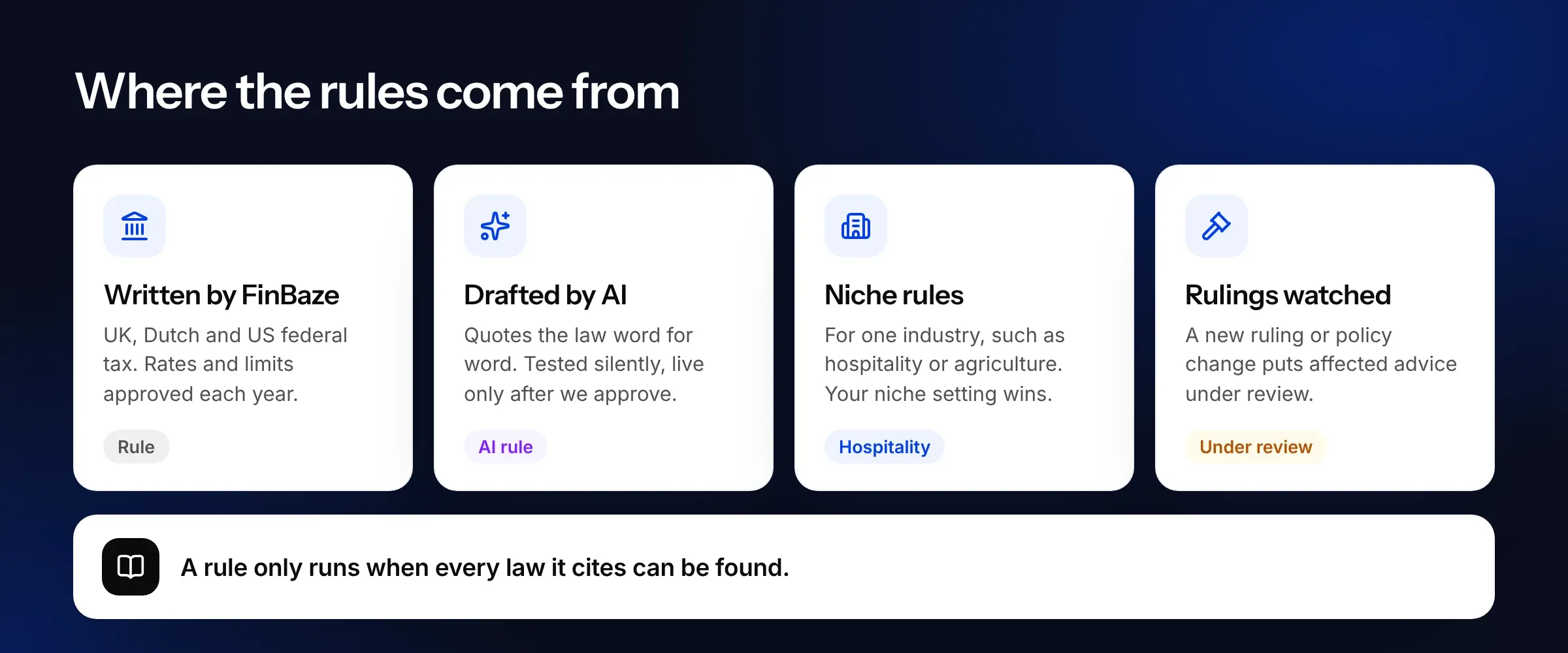
- Rules written by FinBaze. Each rule cites the law it applies. Yearly amounts such as rates and limits are approved by us before a rule uses them, and a rule only runs when every law it cites can be found.
- Rules drafted by AI, reviewed by FinBaze. AI drafts new rules from the law and guidance in the knowledge base. Each one quotes the law word for word, is tested on companies without showing anything, and goes live only after we approve it.
- Niche rules. Some rules only apply to one industry, such as hospitality, construction or agriculture. FinBaze places your company in a tax niche from its SIC code and its figures. You can set it yourself, and your choice always wins.
- Rulings and policy changes. FinBaze watches for new court rulings and policy. When one may affect a rule, its points show a notice that the advice is under review.
The AI tax advisor
Rules cover what someone thought of in advance. The AI tax advisor looks at one company's books against the law and proposes points nobody wrote a rule for.
It can run a quick check, look at a new period or do a full review over several years. Each finding must quote at least one passage of law or guidance word for word and point at real records in your books. An amount is only shown when the advisor calculated it from your books. Findings show how sure the advisor is.
Your bookkeeper reviews first
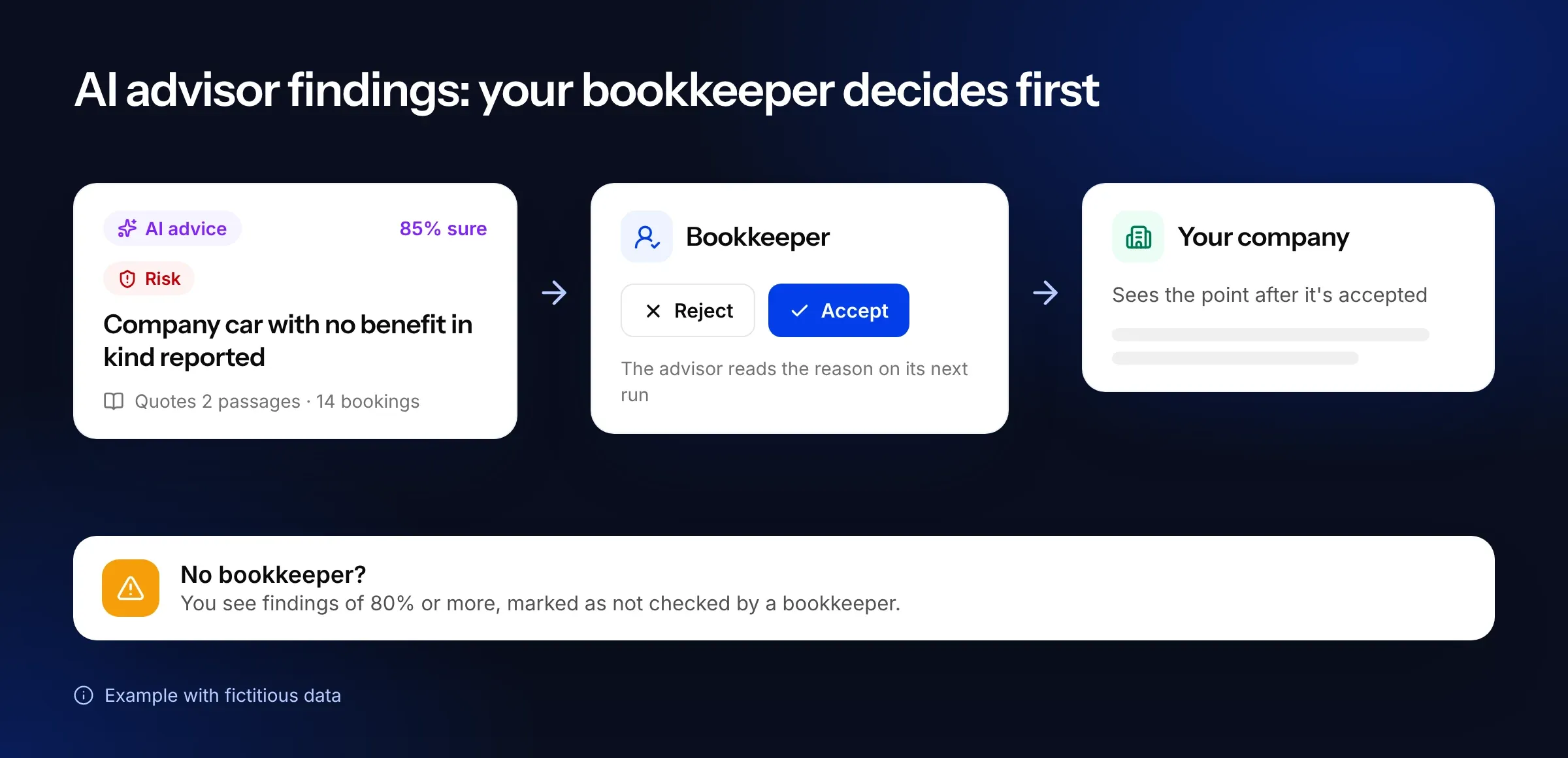
If your company has a bookkeeper, every advisor finding goes to them first. You only see it once they accept it. If they reject it, the advisor reads their reason on its next run, and a new run never overrides their decision. Without a bookkeeper, you only see findings the advisor is at least 80% sure of, marked as unchecked.
For practices, Tax advice in the firm gives an overview of every client's open points, plus the findings that wait for review.
What FinBaze never does
- It never submits a return. Submitting always needs a person.
- It never overwrites boxes, bookings or amounts. You make the change.
- It never shows an advisor finding to a company with a bookkeeper before the bookkeeper accepts it.
Tax intelligence is explanation, not personal tax advice. Estimates are indicative. Check with your adviser before you act on them.
Availability and pricing
Tax points, niche rules and Search tax law are available now on plans that include the AI assistant. The AI tax advisor and AI-drafted rules are in beta: we switch them on per company or practice.
Advisor runs use AI credits. You see the credits of each run, and a company spends at most 1,000 advisor credits a month by default.
Want the advisor for your company or your clients? Book a call. We'll switch it on and go through the first review with you.
Frequently asked questions
Is a tax point personal advice?
No. It explains what the law says and how it relates to your books. Check with your adviser before you act on it.
Which countries are covered?
The United Kingdom, the Netherlands and US federal tax.
Can I see the law a point is based on?
Yes. Every point links to its sources, and the version that applied in that period.
Why don't I see a finding the advisor made?
Your bookkeeper hasn't accepted it yet, or rejected it. Without a bookkeeper, you only see findings the advisor is at least 80% sure of.
FinBaze points. You decide.